
There is one night in Varestal where nobles fear honesty more than any kind of assassination.
One night where kings will hide their faces.
Where enemies must dance together.
Where betrayal can happen inches from a smile and no one remembers your name by the morning.
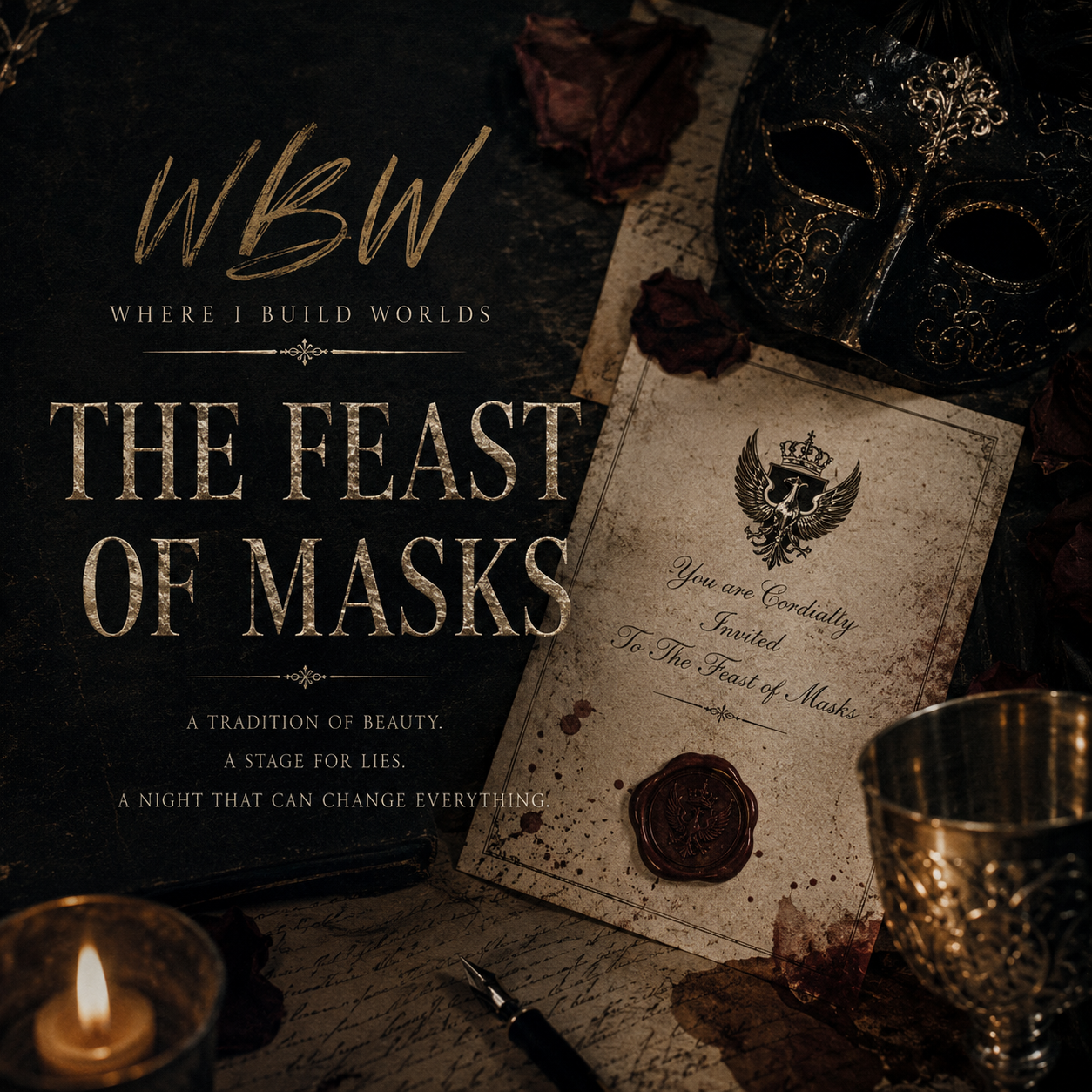
The Feast of Masks.
A celebration older than the modern kingdom itself.
And depending on who you ask…
Either the most beautiful tradition in Atherra.
Or the reason House Drakemore never fully trusts anyone.
Held once every five years within Dravengarde’s palace walls, the Feast of Masks was originally created after the first unification wars of Varestal.
The old chronicles claim the early kings realized something terrifying:
Most wars did not begin on battlefields.
They began at their own dinner tables.
In whispered conversations.
In wounded pride.
In glances exchanged between rival houses that were pretending to be allies.
So the crown created a tradition meant to force the nobility into temporary equality.
On the night of the feast, every guest must wear a mask.
No banners.
No sigils.
No family colors.
For a few hours, a duke may speak to a servant without knowing.
A prince may dance with an enemy.
A killer may share wine beside the man he intends to destroy.
And no one is allowed to reveal themselves until the final bell rings.
At least…
That is how the tradition began.
Over time, the Feast became something far stranger.
Some noble houses use it for diplomacy.
Others for seduction.
Others for blackmail.
Deals have been made there that reshaped entire kingdoms.
Affairs began there.
Blood feuds too.
It is said one Morgrave duke once left the feast with a dagger between his ribs and still finished the final dance before collapsing.
Another story claims a queen discovered her husband’s conspiracy only because she recognized his cologne beneath the mask.
In Dravengarde, people say you learn more about a person when they hide their face than when they reveal it.
Because masks do not conceal desire.
They free it.
The masks themselves are deeply symbolic.
Members of House Drakemore traditionally wear dark obsidian masks lined with silver, meant to resemble dragons watching from shadow.
House Morgrave favors iron-plated designs with narrow eye slits and sharp features, more intimidating than elegant.
House Marcentis often arrives in masks decorated with gold filigree, pearls, and painted ocean patterns inspired by eastern trade routes.
Some lesser nobles commission masks years in advance.
Others intentionally craft unsettling designs meant to spark rumors before they even enter the ballroom.
But the most feared masks are always the plain ones.
Because the truly dangerous people rarely need attention.
The feast itself transforms Dravengarde.
The palace halls are lit entirely by candlelight.
Musicians are hidden behind silk curtains so their faces remain unseen.
Perfume and incense cloud the air so heavily that guests struggle to identify one another by scent.
Even the guards participate.
No names are spoken.
No titles acknowledged.
Only the King may remain unmasked.
And even then…
There are records of Drakemore kings choosing to wear one anyway.
One of the oldest legends surrounding the Feast of Masks tells of a woman known only as The Silver Veil.
No records identify her house.
No paintings survive.
But according to court accounts, she attended three separate feasts across fifteen years without aging.
Each time, she danced with a different member of the royal family.
And each of those royals died before the next winter.
Some believed she was an assassin.
Others believed she was a spirit tied to the old ruins beneath Dravengarde.
The most paranoid historians insist the crown knows exactly who she was.
And intentionally erased her from history.
The modern Feast of Masks is smaller than it once was.
After wars, betrayals, and the growing instability of the kingdom, many houses no longer trust the tradition.
Some fear hidden blades.
Others fear hidden truths.
But the feast still survives.
Because despite everything…
The nobility of Varestal cannot resist pretending to be someone else for one night.
And perhaps that is the most dangerous part of all.
Because in Varestal, power is rarely revealed in daylight.
It lives in whispers.
In hidden smiles.
In masked figures dancing beneath candlelight while kingdoms quietly decide who will survive the coming years.
And somewhere within the halls of Dravengarde…
There are still masks hanging untouched that no servant dares throw away.
No one knows who wore them.
Or why some of them occasionally disappear before the feast begins.
— E.J. Cordoue,
Chronicler of Varestal.
Where kingdoms rise, and crowns shatter.

Leave a Reply