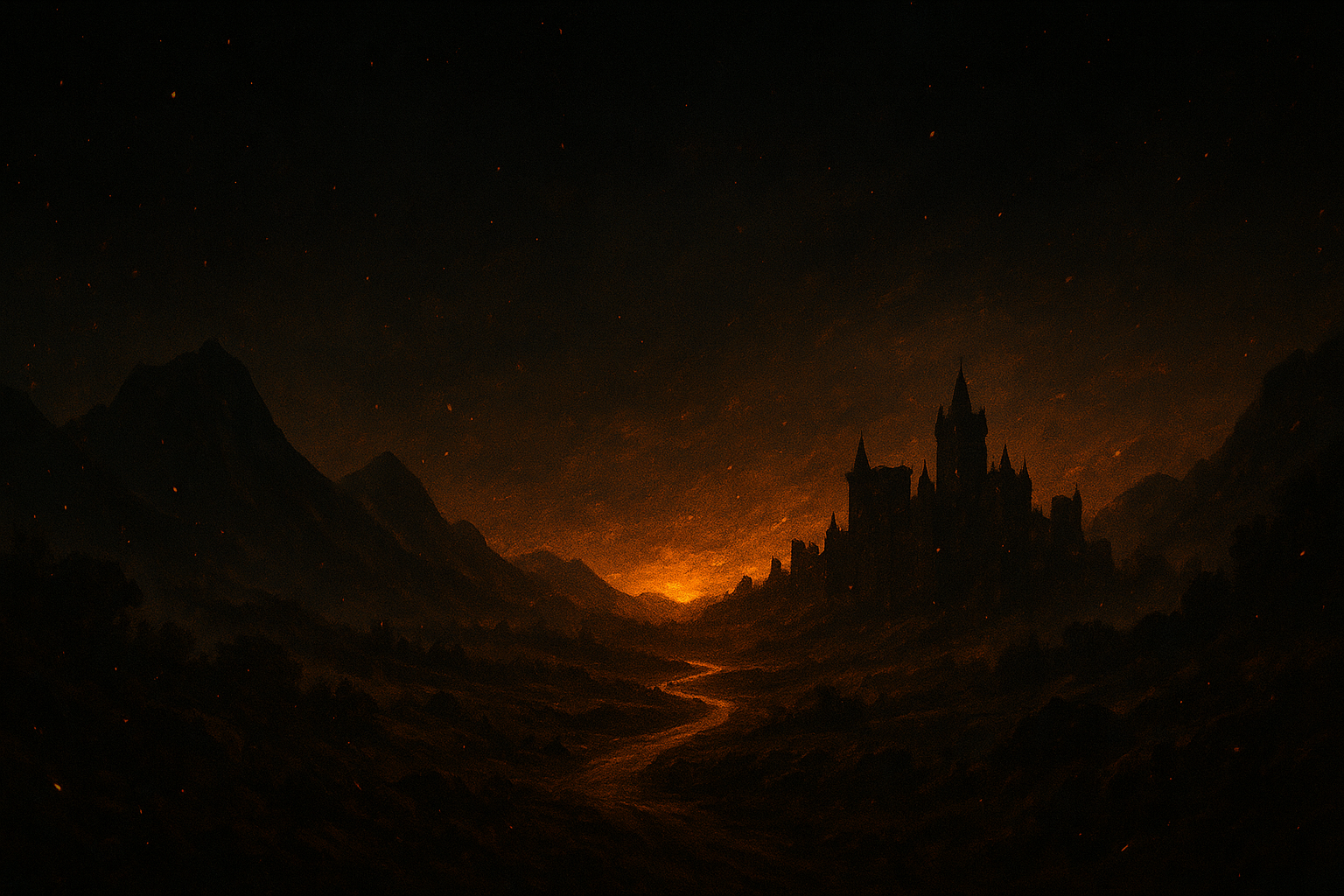

A pale morning light filtered through the fractured windows of Dravengarde’s royal palace, casting weak, angular rays across the half-collapsed halls. Overnight, a cold wind had swept the city’s charred rooftops, dispersing the lingering smoke until only a faint, bitter smell clung to the air. Yet in that stillness, life persisted. Villagers and refugees, freed at last from tyranny, drifted in search of loved ones, while ragged knots of rebels stood guard at every battered archway.
Caelan awoke from a fitful rest in a small chamber adjoining the throne room. A threadbare tapestry, marred by soot, served as his makeshift bedroll against the hard marble floor. He blinked the grogginess from his eyes and pushed himself upright, rubbing at an ache in his shoulder—a fresh reminder of the final battle’s bruises. Even in these fleeting moments of quiet, the weight of the kingdom pressed against his chest like an anvil.
He had scarcely found his feet when a soft knock sounded at the door. Eira entered without waiting for a response, her posture as straight and sure as ever, though dark circles under her eyes betrayed her own exhaustion.
“Morning,” she murmured, offering him a cup of water. “You slept like a stone. We’ve been trying to give you space, but there’s already a small crowd gathering in the palace courtyard—townsfolk, a few nobles. They want answers.” She hesitated. “And they want you.”
Caelan swallowed a mouthful of water, letting the coolness settle into his parched throat. His mind churned with the memories of the last council—plans half-formed and bargains struck in the haze of a city still smoldering. “I’ll talk to them,” he said, forcing a note of determination into his voice. “Just—give me a moment.”
Eira nodded and pulled out a rumpled piece of parchment. “I made a rough inventory of everything we’ve got—food reserves, medical supplies, salvageable structures. It’s not much. Even the central granary is in bad shape. People are already going hungry.”
A pang of guilt twisted Caelan’s stomach. The joy of overthrowing the Duke had faded too quickly, replaced by the harsh reality of rebuilding a kingdom. “We’ll figure it out,” he said, though the words felt woefully inadequate. “Have Lysander organize relief efforts. We’ll start by distributing whatever food is left in the palace stores.”
Eira’s eyes flickered with approval. “Done. He’s gathering volunteers. Gavik’s gone with a few squads to root out the last Duke loyalists in the catacombs. Might take them all day.”
Before Caelan could respond, another knock came at the door. A timid rebel soldier poked his head in. “Pardon, Commander… or King… or…” He trailed off, blushing with confusion. “They’re waiting for you outside. More are arriving by the minute.”
A wry smile tugged at Caelan’s lips. “I’ll be out there soon. Thank you.” The soldier ducked away, and the door clicked shut once more.
Eira folded her arms, her gaze settling on Caelan with a mixture of sympathy and challenge. “Time to face them, then. Whether you like it or not, they’re seeing you as a leader now.”
Caelan raked a hand through his hair, exhaling slowly. “I’m no Duke, Eira. And this wasn’t exactly part of my plan.”
“Plans change,” she replied gently. “You always said this rebellion was about giving the people a voice. Maybe hearing them out is how we start doing that.”
Her words struck a chord. Caelan pictured Dravengarde’s winding streets, the defiant faces of those who had refused to kneel, and the scars left by tyranny. He recalled Brenna’s smile, so full of hope for a better tomorrow. He drew in a breath and stood a little straighter, ignoring the protests of his battered body.
“All right,” he said, voice steadier than he felt. “Let’s go meet them.”
He and Eira stepped into the corridor, where a few rebels saluted—an awkward, makeshift gesture of respect. The palace was no longer just a monument to oppression; it had become a rallying point for survival. Tapestries bearing the Duke’s emblem hung in tatters, stone pillars stood blackened with soot, and the shattered remnants of a once-opulent chandelier lay strewn across the marble floors. Every ruin was a reminder of the cost of victory.
They made their way through the labyrinthine passageways until they reached a grand, arched doorway. Outside, early sunlight bathed the courtyard in a diffuse glow, revealing a crowd that had swelled to nearly a hundred souls: ragged townsfolk, curious children clinging to their parents, wounded rebels leaning on crude crutches, and a scattering of nobles standing uneasily at the margins.
At the sight of Caelan, a ripple of tension passed through the assembly. Conversations died down, eyes turning expectantly toward him. He swallowed, stepping forward with Eira close at his side. Overhead, the distant caw of scavenger birds echoed through the silent city.
A middle-aged woman, her face etched with both fear and cautious optimism, stepped out of the throng. “Our homes are gone,” she said, voice trembling slightly. “We’ve… we’ve got nothing left. What do we do now?”
A murmured agreement went through the crowd—an uneasy hum of desperation. This was the cost of liberation, Caelan thought. They had torn down the Duke, but the pillars of society had crumbled in the process. All these people looked to him for hope, for a plan, for the security they’d been denied.
His chest tightened. So many battles fought, so many losses. And now, perhaps the hardest task of all: to rebuild.
He lifted his chin, meeting the woman’s gaze. “We start with what we have,” he said, raising his voice enough to reach the back of the courtyard. “We’ll clear the rubble together, reclaim any supplies, and establish safe shelters. The palace itself—ruined though it is—will serve as a hub for relief. If your family needs food or medical help, come here.”
In the crowd, a noble cleared his throat. Caelan recognized him from the hasty council. “And what of… governance?” the man asked stiffly, as if fearful of the very word. “Your—your Grace. Are you—will you assume the throne?”
The hush that fell was palpable, charged with a collective breath. Caelan could almost feel the weight of the battered palace behind him, the silent throne room an echo of decisions he couldn’t postpone forever. Yet he’d promised Lysander he would sort out immediate survival first.
He looked over the faces surrounding him—some tear-streaked, some expressionless, all filled with longing for a certainty that eluded them. “I’m not here to become your new tyrant,” he began carefully, ignoring the noble’s address. “We’ve all lost too much to see another set of boots on our backs. I don’t have all the answers, but if we work together, if we share what we have left, we can find a path forward. And as for the throne—” He paused, heart pounding. “We’ll settle that once we’ve ensured no one starves or bleeds to death in these streets.”
A flicker of relief crossed some faces; others looked uneasy at the noncommittal response. Still, no one protested openly. The hush that followed felt different from the hush of fear under the Duke’s rule—this was a silence of hesitant trust, like strangers gathering around a single flame in the dark.
Caelan drew in a steadying breath. “For now, let’s make sure you’re safe. Lysander is organizing patrols and supply runs. If you can hold a weapon, volunteer. If you have medical skills, help in the triage area. We’ll rebuild Dravengarde from the ground up.”
Slowly, murmurs of agreement spread through the crowd. People began to disperse in small groups, some heading toward the palace to seek help, others uniting for cleanup or scouting for salvageable goods. The entire courtyard seemed to release a collective sigh—a first, tentative step away from chaos.
By his side, Eira offered a small nod of approval. “Could have been worse,” she remarked. “They’re listening.”
Caelan let out a breath he hadn’t realized he’d been holding. “It’s a start,” he murmured. Yet as he gazed at the scorched battlements overhead, he couldn’t shake the feeling of standing on a razor’s edge. The city yearned for a leader, the kingdom longed for stability, and he was caught between destiny and doubt.
Clouds drifted over the rising sun, tempering the rays that fell upon the battle-scarred courtyard. Yet even in the filtered light, Dravengarde’s devastation stood starkly visible. Rubble choked the once-proud avenues, and scraps of scorched banners clung to broken columns. Here and there, the unmistakable tang of smoldering wood wafted through the breeze.
Caelan lingered in the courtyard after the crowd dispersed, watching as small groups formed around makeshift fires, attempting to cook whatever meager provisions they could gather. Rebels, noble retainers, and frightened townsfolk rubbed shoulders in uneasy cooperation. Soldiers in worn tabards tried to usher order where chaos still reigned.
He flexed his stiff fingers, still aching from the final battle. For so long, the rebellion’s objective had been singular—topple the Duke. Now that the tyrant lay dead, a new kind of fight had begun, one that demanded compassion and diplomacy rather than steel.
Lysander approached from across the courtyard, weaving around a shattered statue of some forgotten hero. A twinge of relief softened his lined face. “The supply teams have organized a distribution point by the old stables,” he reported, pushing damp hair from his brow. “We found a few untouched storerooms. Not nearly enough, but it’s a start.”
“That’s something, at least,” Caelan replied. His gaze darted to the battered palace gates, where a cluster of women and children huddled close, eyes filled with both fear and guarded hope. “How are people faring?”
Lysander sighed. “Better than I expected, honestly. They’re tired, hungry… but they’re not cowering like they did under the Duke. Word is spreading that you’re not planning to seize power with an iron fist.”
Caelan swallowed the dryness in his throat, remembering the half-ruined throne lurking in the palace’s shadowy hall. “I suppose I’m not. But they still need someone to steer this chaos.”
A flicker of sympathy crossed Lysander’s face. “Just don’t let the weight crush you, lad. You’ve got Eira, Gavik, and me to share the load.”
As if on cue, Eira appeared, lightly jogging from the far side of the courtyard. Her usually stoic expression held a tinge of urgency. “There’s news,” she said quietly, pausing to catch her breath. “A handful of Duke loyalists have barricaded themselves in a guardhouse near the eastern gate. They’re refusing to surrender, and we can’t risk letting them regroup.”
Caelan’s eyes hardened. “Do they have hostages?”
“Seems not,” Eira replied. “Just cornered soldiers who can’t accept the Duke’s death. They’ve taken potshots at anyone who strays too close. We can overwhelm them easily, but it’d mean more bloodshed.”
He grimaced. “We need them alive if possible. The kingdom’s had enough executions.”
Lysander nodded. “I’ll assemble a team. Maybe we can talk them down.”
Before he could move, another voice joined them—gruff and unmistakably Gavik’s. “I’ll come too.” He emerged from behind a collapsed pillar, his axe strapped across his back. A fresh bruise colored his temple, and dust clung to his dented armor. “Just cleared out another nest of Duke’s dogs in the catacombs,” he reported, a trace of savage pride in his smile. “They put up a fight, but nothing we couldn’t handle.”
Eira gave him a brief, approving nod before turning back to Caelan. “You want to handle those loyalists yourself, or shall we take care of it?”
Caelan hesitated, recalling the watchful eyes in the courtyard. If he personally led another assault, he risked stoking more fear—bloodshed was precisely what he’d vowed to curtail. Yet ceding too many responsibilities could undermine his leadership. “Lysander and Gavik, go,” he decided at last. “Try reasoning first. Eira can coordinate the perimeter. I’ll remain here—someone needs to keep things steady if more trouble stirs.”
“Got it.” Eira jerked her head in agreement and moved off to gather a perimeter detail.
Gavik slapped Caelan on the shoulder, a gesture that bordered on friendly and fierce. “Don’t worry, we’ll make ’em see sense. Or knock it into them.”
“Gavik,” Caelan warned, voice laced with weariness. “No unnecessary violence.”
Gavik’s grin flashed. “Sure thing, Commander.” With that, he and Lysander headed out, their armor clinking as they disappeared into a maze of fallen timbers and fractured walls.
Caelan inhaled, letting the swirl of dust-laden air fill his lungs. He cast a lingering look around the courtyard—children nibbling on stale rations, a blacksmith’s apprentice trying to salvage iron scraps, a ragged group of displaced farmers rummaging for anything edible.
Somewhere in this broken city, the seeds of a new era lay dormant. But the ground was still choked with the debris of war, and the sun overhead felt cold, unwelcoming.
His attention shifted to a small knot of townsfolk near the palace entrance, where a middle-aged man with a bandaged arm stood addressing two youths in tattered cloaks. The man spotted Caelan and offered a half-bow, his expression a mix of respect and trepidation. “We’re… we’re heading to the western outskirts,” he called uncertainly. “I—I heard there might be farmland not burned. Maybe we can harvest something before winter sets in…”
Caelan forced a faint smile. “Take caution. If you find anything, let us know. We’ll help distribute it fairly.”
The man nodded earnestly. “Yes, m’lord. Thank you.”
M’lord. The title pricked at Caelan’s conscience—he’d shed noble airs long ago, but the people seemed to cling to any form of respect that gave them structure. He watched them depart, forging a path through rubble with stiff, limping steps, the future uncertain yet beckoning them onward.
A sudden wave of exhaustion washed over him. The weight of the kingdom felt heavier than any sword he’d lifted. Some part of him longed to vanish into the silent forests beyond Varestal, to trade the clamor of duty for the peace of anonymity. But another voice, that of loyalty and guilt, anchored him here.
He exhaled slowly, raking a hand through his hair. No, I can’t abandon them now. The memory of Brenna’s final stand flickered in his mind, her voice urging him forward. If her sacrifice and those of countless others meant anything, it was that the people deserved a leader who wouldn’t shirk responsibility, no matter how suffocating it became.
He stepped into the palace’s half-collapsed foyer, where the scent of charred wood and stale incense clung to the cold stone. A few nervous nobles had regrouped there, whispering in hushed tones about what would come next—whether Caelan would claim the throne, or if a council might form. He met their eyes, forcing a courteous nod that almost felt surreal, given the swirling chaos around them.
Moving past them, he reached the corridor leading to the battered throne room. Jagged holes in the walls revealed glimpses of the ravaged city outside. The torn draperies still bore faint traces of the Duke’s crest—a stark reminder of tyranny’s lingering imprint.
This is what remains, he thought, stepping over scattered debris. An empty throne. A city on the brink. A kingdom holding its breath.
Yet as he continued onward, the faint sounds of reconstruction trickled in—voices organizing relief, the scrape of rubble being cleared, and the muffled ring of a hammer forging something new. These were the fragile echoes of hope, weaving themselves into Dravengarde’s scars.
Caelan lingered in the corridor outside what remained of the throne room, steadying himself against a fractured pillar. Every inch of Dravengarde’s battered palace seemed to carry the echoes of conflict—metal scraping against stone, hushed conversations laced with apprehension, distant coughs of the wounded. He found his own pulse slowing, as though the magnitude of his new responsibilities were a physical weight pressing down on him.
From somewhere beyond the towering, half-collapsed arches, he heard a familiar voice: Eira, speaking in hushed but urgent tones. When he followed the sound, he discovered her conferring with a small group of archers in a rubble-strewn courtyard. Her posture was rigid, her gestures purposeful—clearly giving instructions.
“Two scouts heading west,” she said, eyes flicking over a hastily drawn map. “Keep to the ravines if you can. The Duke’s forces might’ve hidden supply caches or weapons. Don’t engage unless threatened. Got it?”
The archers nodded, saluted in a ragged fashion, and hurried off. Only then did Eira notice Caelan’s approach. “We’re short on everything,” she said bluntly, answering his unvoiced question. “Arrows, bandages, basic rations… if we don’t find more supplies soon, we’ll be fighting starvation next.”
Caelan exhaled, running a hand through his hair. “Keep me updated. Lysander and Gavik should return soon with news about those holdouts.”
Eira’s expression softened slightly, the tension around her eyes easing. “We’ll hold things together until then. There’s talk of setting up a more permanent triage center in one of the palace wings, away from the worst damage. I’ll coordinate with any healers we can find.”
A flicker of gratitude stirred in Caelan’s chest. She’s as determined as ever. “Good,” he replied, voice quiet. “I appreciate it. Once we get a sense of the city’s resources, we’ll figure out how to distribute them. We can’t afford chaos right now.”
Eira gave a curt nod and left to see to her next task, leaving Caelan to navigate deeper into the palace’s ruined passages. Thin shafts of daylight pierced the roof where mortar and stone had crumbled, illuminating walls blackened by soot. Every step reminded him of the fragility of this hard-won peace. With the Duke gone, the people looked to him for stability—a burden he both feared and felt honor-bound to shoulder.
He nearly collided with a trio of battered rebels escorting a fearful young noble and his retinue. The noble, a slim man whose velvet cloak had been singed and soiled, paused mid-argument. “I tell you, we had no choice but to follow the Duke,” he insisted, voice trembling. “He held our families hostage… Are we to be punished for what we couldn’t control?”
Caelan raised a hand for calm. He recognized the anxious flush on the noble’s face—fear of reprisal. “No one’s being punished without cause,” he said firmly. “If you truly served under duress, help us now. We need every able soul to rebuild. Prove your good faith, and Dravengarde will have room for you, too.”
Relief warred with skepticism on the noble’s face, but he nodded. “Yes… yes, of course,” he stammered. “Thank you.”
Once the noble and his companions moved on, the rebels exchanged glances of wary acceptance. Caelan could feel the tension that still simmered—old allegiances dying hard, resentments flaring beneath the surface. Yet, if the kingdom was to stand a chance, these fractured pieces would have to fit together somehow.
Pressing on, he emerged into a chamber where the ceiling had caved in, revealing the open sky overhead. What had once been a grand library lay in a shambles—scattered scrolls and charred books heaped among splintered shelves. A lone survivor of the Duke’s tyranny, perhaps an old scholar, knelt among the tattered remains, trying to salvage any legible fragments.
Caelan approached, crouching beside the man. “Is there anything we can save?” he asked gently.
The scholar shook his head, eyes misty behind cracked spectacles. “Decades of knowledge… gone. We might salvage a few tomes. But it’s… tragic.”
Sympathy twisted in Caelan’s heart. Even as they fought to ensure basic survival—food, shelter, safety—he could not ignore the cultural wounds inflicted by war. “Keep what you can,” he said softly. “We’ll need knowledge as much as we need bread.”
Leaving the man to his rescue efforts, Caelan continued through the library’s gaping side door, stepping carefully around crumbled masonry. A sense of surreal emptiness clung to these halls, once corridors of power and intrigue. Now they felt like a mausoleum, full of ghosts. Outside, he could hear faint shouts—someone calling for more medics, another voice rallying citizens to clear debris from the main road.
This is what victory looks like, he reminded himself. Not triumphal processions or cheering throngs, but slow, grinding work to reclaim a city on the brink. The question that gnawed at him—Can I truly lead them?—remained unanswered, and might remain so until the kingdom found its footing again.
At length, he headed back toward the courtyard, the half-collapsed arches framing a sky that had turned midday bright, yet carried the haze of dust and ash. The crowd had thinned, but a steady pulse of activity flowed as people worked, scavenged, consoled each other. He glimpsed a few children chasing a makeshift ball among the rubble, their shrieks of laughter incongruous in the rubble-strewn aftermath.
Pausing by a broken statue, he swallowed the knot of uncertainty lodged in his throat. In that hushed moment, Caelan realized the truth: every day from here on was going to be a test of compassion, of resolve, and of unity. The war had taken so much, yet its scars might forge a nation stronger than fear—if only they could piece together the fragments scattered at their feet.
Late afternoon sunlight slanted through the shattered arches of Dravengarde’s great hall, warming the ruined stone with a soft, golden glow. Where once the Duke’s power had cast a long, menacing shadow, now rows of citizens, rebels, and even humbled nobles gathered in cautious unity. Beneath broken tapestries and scorched pillars, a makeshift dais had been erected—planks hammered together where the Duke’s throne once towered in ominous splendor.
Caelan stood at one edge of the dais, heart pounding. The days since the siege had been a haze of rebuilding, desperate negotiations, and quiet heroics by people determined to salvage the kingdom they’d nearly lost. Supplies trickled in, battered families found shelter behind half-collapsed walls, and whispers floated through the streets: When will Caelan formally take the throne? Is he the leader we need—or another usurper?
He glanced around, meeting the eyes of those who had fought alongside him:
Eira, arms folded, stood on the side of the platform, her bow slung over her back. Despite the stoic set of her jaw, her expression flickered with pride.
Gavik, bruised and bandaged, had claimed a spot near the foot of the dais. His axe was propped at his side, a silent statement that he’d protect his leader to the end.
Lysander lingered behind Caelan, a steady presence in the swirl of uncertainty, ready to step forward if doubt overwhelmed him.
A hush fell over the crowd as a handful of elders—remaining nobles, priests, and respected townsfolk—took their places. An elderly priestess, her robes singed at the hem, stood before Caelan, the remnants of a ceremonial staff in hand. Though her voice quavered with age and exhaustion, it carried across the hall with surprising clarity.
“Today, we gather to heal what was broken,” she proclaimed. “The Duke’s reign tore at the fabric of our kingdom, our very souls. But in our darkest hour, we found a leader among us—one who risked his life and the lives of those dearest to him, so that Varestal might know freedom once more.”
A murmur rippled through the onlookers. Caelan swallowed hard, forcing himself to stand taller. He could feel the weight of every sacrifice, every life lost. Brenna would want this, he reminded himself. She’d want me to do what’s right.
The priestess turned, her lined face solemn. “By the will of the people, and with the blessing of those who have shed blood and tears for this land, we ask Caelan to ascend as steward and guardian of Varestal, to guide us out of tyranny’s shadow and into a new dawn.”
There was no grand, jeweled crown for a ceremony that had been assembled in such haste. Instead, Lysander stepped forward, carrying a circlet of wrought iron—simple, unadorned, yet hammered by a local blacksmith to represent the burdens of leadership. For a beat, Caelan hesitated, memory flashing with the countless battles he’d fought just to end another man’s claim to rule. Am I truly worthy? he thought, anxiety roiling in his stomach.
But Lysander’s eyes were steady, reflecting a trust that transcended fear. Slowly, he placed the iron circlet upon Caelan’s head. A profound hush enveloped the hall, as if the very stones were holding their breath.
Caelan faced the crowd—farmers, blacksmiths, orphans, guards, and even the apprehensive nobles. The hush broke as quiet applause and sighs of relief rippled through them. A breeze drifted in from the shattered windows, carrying the faint aroma of smoke and hope, mingling with the soft rustle of shifting feet. His heart thudded, but a new, subtle calm settled over him.
“I never wanted this,” Caelan began, voice a touch unsteady. “I fought because I couldn’t stand by while people suffered. I took up arms with you so that we could be free of tyranny—so our children wouldn’t live in fear of the next dawn. But now I see that freeing you is only half the task. We must rebuild a kingdom we can all be proud of, a place where no one cowers under cruelty.”
He paused, letting the magnitude of his promise sink in. “I will not rule you by fear. I will not hoard power or wealth. We have lost too much for such greed. I stand here as your servant, and if ever I fail to remember that, you must remind me. Together, we will rebuild Varestal—not as it was under the Duke, but as it could be: just, united, and alive with possibility.”
A wave of emotion swept the hall. Some people openly wept; others touched the arms of neighbors in relief or clasped hands in silent prayer. Gavik grinned, clapping once, prompting a smattering of applause. Eira, hands clasped behind her back, offered a single nod that spoke volumes of her respect. Lysander gently laid a hand on Caelan’s shoulder, a gesture of unwavering support.
In that moment, the battered city seemed to inhale as one. This was not a coronation drenched in luxury or pomp—no gilded crown or lavish banquets. It was, instead, a solemn vow in the ashes of tyranny, a humble acceptance of a burden shared among all who stood within those scorched walls.
As Caelan stepped down from the dais, he could almost feel the weight of the iron band pressing into his brow, the hopes of countless souls tethered to his every breath. But amid the fear, he sensed a collective spark of belief—a flicker of genuine faith that things could be different. We’ll make this work, he told himself, together.
Outside, a soft breeze wafted through the palace courtyard, stirring the dust motes in the late afternoon sun. The new King of Varestal—though he would likely never grow used to that title—looked upon the faces of those who had chosen him, or at least accepted him, as the dawn’s herald. For better or worse, the future was now in his hands.
Far above, the skeleton of a broken spire caught the waning light, like a silent witness to a new era. And though the city still bore the wounds of war, a cautious sense of renewal pulsed in every footstep, every whispered conversation. Varestal had found a leader among the ruins—a man shaped by grief, duty, and an unyielding desire to see his people live unbound by fear.

Leave a Reply